

Corporate Venture Studios: Lessons from the Trenches

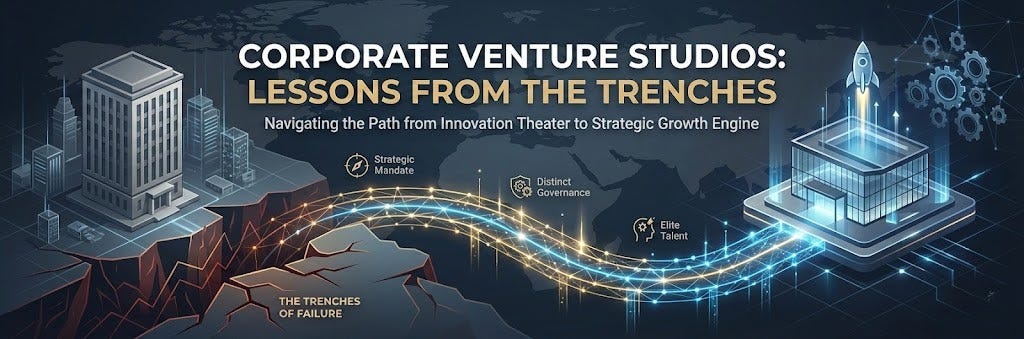
The allure of the corporate venture studio is undeniable. Faced with the Innovator’s Dilemma, legacy organizations see the studio model as a silver bullet: a way to capture the agility of a startup while leveraging the unfair advantages of the incumbent. In the last five years, the number of corporate venture studios has exploded, with companies ranging from banks to industrial giants launching dedicated units to build, rather than buy, their future growth engines. Global Corporate Venturing’s 2025 report on venture building found that 30% of corporations with Corporate Venture Capital groups operated a venture builder as well and 69% of them started in the last six years.
Yet, the graveyard of failed corporate studios is growing just as fast.
The disconnect lies in a fundamental misunderstanding of what a venture studio actually is. It is not an incubator. It is not an R&D lab. It is not a faster product development group. It is an entirely distinct asset class that requires a governance model, talent strategy, and strategic mandate radically different from the core business.
To understand why some studios evolve into strategic powerhouses while others devolve into “innovation theater,” we analyzed insights from seven veteran practitioners. These are experts who have designed and operated studios across diverse industries. Their collective “ground truth” offers a sobering but necessary correction to the hype. When combined with emerging frameworks on studio governance and intelligence generation, a clear pattern emerges: success depends less on the creativity of the ideas and more on the structural integrity of the vessel.
Here are the critical lessons from the trenches.
I. The “Honesty Test”: Defining the Strategic Mandate
The most common point of failure occurs before the first employee is hired. Too many organizations launch studios with a vague desire to “innovate” or “diversify,” without defining the specific boundary conditions of their ambition.
Marcus Daniels, Founding Partner & CEO of Highline Beta, warns that the biggest mistake companies make is “starting with the mechanics instead of the clear strategic intent.”. He argues that the true starting point isn’t a budget line item, but an “executive growth mandate” to build beyond the core.
Taylor Black, who leads strategic programs and incubation at Microsoft, argues that the starting point must be a “brutally honest diagnosis of the corporation’s strategic aperture.” Black advises leaders to map “the zones where the company has both permission to explore and the will to act.” Without this focus, studios drift. “Most failed studios were launched around a vague desire to ‘innovate’... rather than a clear understanding of the parent company’s long-term strategic constraints,” Black notes.
This requires moving beyond the standard corporate strategy deck and answering uncomfortable questions about control. Mark Simoncelli, CEO of LaunchStone, administers what he calls the “honesty test” to leadership teams. “Before launch, I ask one simple question: what are you prepared to stop governing through traditional processes?” Simoncelli says. “If the answer is vague, the studio will end up negotiating for permission rather than building ventures.”
The mandate must also be anchored in the correct time horizon. Neal Ghosh, Managing Partner at 9point8, emphasizes that a studio is a tool for the “10-year strategy.” If the corporate goal is incremental growth, a studio is the wrong tool. “If the strategy is predicated on net-new businesses... then a studio is a must-have arrow in the quiver,” Ghosh explains.
Elliott Parker, CEO of Alloy Partners, warns against the trap of using studios for near-term P&L fixes. “Revenue augmentation, by the way, is a terrible reason for launching a corporate venture studio,” Parker asserts. Instead, he argues the mandate must be about “seeing around corners” and creating “long-term strategic optionality.”
The Strategic Takeaway: Do not launch a studio to fix next quarter’s numbers. Launch it to solve the problems that your current operating model is structurally incapable of solving. If you cannot name the specific “strategic frontier” (to use Simoncelli’s term) that the core cannot reach, you are not ready to build a studio.
II. The Governance Trap: Preservation vs. Creation
Once the mandate is set, the next hurdle is the “corporate immune system.” Corporations are optimized for efficiency, risk reduction, and the protection of existing assets. Startups are optimized for discovery, speed, and the rapid invalidation of bad ideas. When these two operating systems collide without a buffer, the corporation invariably kills the startup.
Elliott Parker frames this as a fundamental difference: “Corporations are optimized for preserving; startups are optimized for creating.” He explains that the governance designed to perpetuate predictable performance will cause a venture system to fail. “For a corporate venture studio to succeed, it needs a very different system of governance... a system designed and optimized for making mistakes and learning, not for scaled, capital efficient execution.”
This friction often manifests in the urge to integrate new ventures into the core business too early, a practice that practitioners universally condemn. Alice Liu, SVP and Head of Innovation at Huntington National Bank and former Head of the Stanley Black & Decker venture studio, identifies this as a critical mistake. “The biggest mistake is forcing new ventures to integrate with the core business too early... it consistently kills momentum,” Liu says. When a studio aligns prematurely with existing product or technology stacks, “you end up with ‘corporate shaped startups’ instead of real ventures.”
Max Volokhoff, Head of R&D and Investments at Mitgo Group, reinforces this, noting that applying mature corporate standards to early-stage projects “suffocates them before they even begin to form.”
Marcus Daniels cautions against “importing Silicon Valley best practices without adjusting for corporate physics.”. He notes that “giant idea funnels” and “endless meetings” might create emotional comfort for executives, but they “undermine the strategic purpose of a venture studio.”
The solution is to position the studio not as a subordinate department, but as a distinct entity with its own “sovereignty.” This aligns with the emerging view that Corporate Development, rather than Innovation or Strategy, is the natural home for venture studios. Corporate Development teams are accustomed to capital allocation, the strategic landscape, and multi-year timeframes. They understand that a venture is an asset to be managed, what it means to integrate a spin in, and when an organization is ready to be integrated.
Mark Simoncelli takes a hard line on this separation: “Ventures should never be integrated early simply because it feels safer. Integration must be earned.” He argues that integration belongs only to ventures that have found traction. “Anything earlier slows the venture and diminishes the opportunity.”
III. The Talent Paradox: Employees Are Not Entrepreneurs
Perhaps the most persistent delusion in corporate venturing is the belief that internal high performers can easily transition into venture founder roles. While internal talent possesses deep domain expertise, they often lack the risk profile and “zero to one” skill set required to build a company from scratch.
“Employees are not entrepreneurs, no matter how talented and capable the former are,” says Neal Ghosh. He points out that while corporations have abundant opportunity and talent, they “desperately overlook” the incentives required to drive entrepreneurial behavior.
Max Volokhoff puts it bluntly: “You don’t ‘attract entrepreneurial talent’; you build an environment where sane, ambitious people can take entrepreneurial risks without behaving like idiots.” He warns that if your best product people feel they have more agency building a side project on the weekend than working in your studio, “your talent strategy has already failed.”
The primary lever for solving this is compensation and equity. You cannot pay a founder a salary and a standard annual bonus and expect them to act like an owner. Elliott Parker advises that the offer must be “better than what they could do on their own.” This means “significant ownership and upside with a faster track to that upside.”
Marcus Daniels adds that attracting this talent is “brutally difficult” because you are asking creatives to operate within constraints they usually avoid.. The solution is designing a model that includes “genuine upside through phantom equity or performance outcomes.” “If you want elite entrepreneurial talent, create a place where they can win on founder-like terms, powered by corporate advantage but not constrained by corporate gravity.”
However, money alone isn’t the draw; the “unfair advantage” is. Taylor Black suggests a counterintuitive approach: “Recruit founders after proving the problem, not before.” Black argues that strong founders aren’t drawn to corporate perks, but to “tractable, well-researched opportunities with asymmetric advantages.” If the studio can de-risk the regulatory and technical foundations, it changes the equation for talent. “Founders suddenly see a path where they can spend 80% of their energy on building and 20% on internal politics, not the reverse,” Black says.
Alice Liu adds that studios should prioritize “serial founders over first-time founders.” Experienced builders appreciate the specific value proposition of a corporate studio, access to distribution and capital, because they have already experienced the pain of building without it.
IV. The Currency of Success: Intelligence, Not Just Equity
In the traditional venture capital model, success is binary: the portfolio company exits, or it dies. In the corporate context, however, a “failed” venture can still generate immense value if the studio is structured as an Intelligence Engine.
The customer discovery process required to build a venture generates thousands of data points regarding unmet needs, pricing elasticity, and competitive dynamics. As Taylor Black notes, the studio is “a portfolio level learning engine.” The output of the studio isn’t just equity value; it is insight that prevents the core business from being blindsided.
However, leadership must value this learning correctly. Alice Liu warns that leaders who “expect traditional business case rigor upfront will unintentionally cripple the studio.” The studio operates on “incomplete information” and “directional signals,” not the certainty of a mature P&L.
This requires a shift in how success is validated. Internal metrics are often misleading. “The best metric for any corporate innovation or venture building team... is the extent to which external investors are clamoring to deploy capital,” says Elliott Parker.
Neal Ghosh agrees, identifying “appetite from external follow-on investors” as the ultimate stress test. If the studio keeps doubling down on internal “pet projects” that cannot raise outside capital, it is creating a closed loop of delusion. “If portcos can’t attract external capital, the studios should immediately reexamine all its operating assumptions,” Ghosh advises.
This “Intelligence Engine” perspective also offers a bridge to financial sustainability. Insights establish value immediately across multiple corporate groups building good will and early wins. As common as quarterly earnings disappointments or strategic priorities shift are, establishing real early wins is not optional. Building revenue generating service businesses alongside strategic venture plays amplifies the intelligence gathering capabilities and builds profit distributions that shield from budget cuts.
V. The Operational Reality: Speed, Mortality, and Chaos
The final lesson from the trenches concerns the visceral reality of operations. A studio is not a sanitized environment; it is a chaotic factory.
Max Volokhoff reminds us of the “high-risk” nature of this asset class. “If the CEO and the board are not emotionally ready for 80%+ portfolio mortality... they should not launch a studio.” He describes the process as involving “chaos,” “inconsistent progress,” and a “temporary drop in corporate standards.”
To survive this chaos, the studio must operate with extreme speed, specifically, decision speed. Mark Simoncelli identifies this as the first thing to validate. “Decision speed is the first thing to validate... If decisions require extended debate, layers of review, or perfect information, the studio will never reach liftoff.”
This speed must be applied not just to building, but to killing. A studio must be a “kill engine” as much as a growth engine. Taylor Black emphasizes that leadership must be comfortable with “sunk cost kills” and “the discomfort of being presented with truths that challenge corporate orthodoxy.”
There is also a critical inflection point in a studio’s life cycle. Taylor Black identifies the shift from “exploration” to “repeatability.” This is the moment where patterns emerge across validated markets. Mark Simoncelli agrees, noting that in year two or three, the studio must shift from “producing concepts to managing a portfolio.” If the governance structure doesn’t evolve to support scaling ventures while simultaneously feeding the funnel, the studio “stalls into a high cost experiment.”
Conclusion: From Experiment to Institution
The insights from Daniels, Liu, Volokhoff, Parker, Black, Ghosh, and Simoncelli paint a consistent picture. The era of the corporate venture studio as a “pet project” of the CEO or CIO is ending. To survive, studios must mature into institutional capabilities, likely housed within Corporate Development, funded by patient capital, and governed by a distinct “operating system” that protects them from the efficiency seeking nature of the core.
For corporate leaders, the path forward involves three immediate actions:
Audit the Mandate: Apply Simoncelli’s “honesty test” Daniel’s “future state thesis” and Black’s “aperture” diagnosis. If you are building a studio to boost next year’s revenue, stop. If you are building it to secure the company’s relevance ten years from now, proceed.
Segregate Governance: Do not let the studio report to a core business unit leader. Ensure it has a distinct path to capital and a governance board that understands early-stage risk. As Parker notes, you cannot have a “corporate startup”—you must have an external venture fueled by corporate assets.
Incentivize for Risk: Stop trying to turn your VP of Sales into a Founder. Create an equity structure that attracts the serial entrepreneurs Liu and Black describe—people who need your assets but demand your autonomy.
As Neal Ghosh summarizes, the studio is a “must-have arrow in the quiver” for any organization betting on net-new growth. But as with any weapon, its effectiveness depends entirely on the discipline of the hand that wields it. The studios that win will be those that treat venture building not as a performance, but as a discipline.Or as Marcus Daniels aptly puts it, like “elite athletics,” where you “train every day... and you measure progress through validated evidence rather than internal excitement.” .
A Special Thanks to our Expert Contributors:
Mark Simoncelli, . Founder and CEO of LaunchStone, an ecosystem orchestrator that helps corporations, investors, and founders turn bold missions into measurable growth. Connect with Mark on Linkedin.
Elliott Parker, CEO of Alloy Partners and a long-time practitioner in corporate venture building, portfolio strategy, and innovation acceleration. Connect with Elliott on Linkedin.
Marcus Daniels, Founding Partner & CEO of Highline Beta, bringing deep expertise in corporate venture studio models, corporate-startup collaboration deals, and early-stage VC investing. Connect with Marcus on Linkedin.
Taylor Black, leader of strategic programs and incubation at Microsoft, guiding enterprise-scale venture incubation and new-business experimentation. Connect with Taylor on Linkedin.
Neal Ghosh, Managing Partner at 9point8 Collective, advising Fortune 500 organizations on venture studio formation, startup partnerships, and growth strategy. Connect with Neal on Linkedin.
Alice Liu, SVP and head of innovation at Huntington Bank and formerly the head of Stanley Black & Decker’s venture studio. Connect with Alice on Linkedin.
Max Volokhoff, Head of R&D and Investments at Mitgo Group, with deep experience in emerging technology scouting, corporate innovation, and venture investment. Connect with Max on Linkedin.
About the Author
Matthew Burris serves as the Senior Director of Research at the Venture Studio Forum, where his mission is to transition venture studios from an emerging asset class to an established asset class. In this role, he leads the creation of the rigorous data frameworks and due diligence standards required for institutional adoption.
This research is built upon the proprietary insights Matthew developed as Partner & Head of Insights at the 9Point8 Collective and study of over 500 venture studios globally. By codifying the methodologies from his advisory work with corporate, university, economic development, and private studios, he provides the Forum with the foundational architecture needed to define the industry.
Connect with Matthew on LinkedIn.