

The 3 barriers stopping institutional allocation into Venture Studios

I recently spoke with a studio that has built three unicorns to date. By any standard metric, they are an immense success.
Yet, they told me it took them 18 months to onboard a single new Limited Partner (LP).
Why? It wasn’t performance. It was categorization. The LP told them that the studio strategy was so distinct from every other investment they made, it took them that long just to wrap their heads around the model and form an opinion to allocate capital.
Here is the reality venture studios face: If raising capital is a massive challenge for a studio with three unicorns, it is a massive challenge for everyone in our industry.
Twelve months ago, venture studios were a fragmented collection of promising experiments. Individual operators proved the model worked, but institutional investors expressed curiosity with no clear path to allocation.
That is what the Venture Studio Forum set out to solve. And we are starting to make headway.
The Architecture of Asset Class Evolution
When you are in the trenches of fundraising for a venture studio, the friction feels unique. It isn’t. History teaches us that every established asset class looked implausible, and unallocatable, at inception.
To understand where we are going, look at where the giants started:
REITs (1960): Dismissed as “accounting gimmicks” that couldn’t actively manage properties. It took 26 years of regulatory reform to unlock them. Today, they are a $2 trillion asset class.
Venture Capital (1975): A “cottage industry” for wealthy individuals with only $49M invested. It took the 1979 ERISA “Prudent Man” clarification to unlock pension funds. By 2020, Yale allocated 23% of its endowment to VC.
Private Equity (1980s): Viewed as “corporate raiders” and “barbarians at the gate.” It took academic validation (Michael Jensen) to shift the narrative to “economic efficiency.” By the 2000s, 90% of major public pensions held PE portfolios.
Asset classes don’t achieve recognition through excellence alone. It is not achieved by individual heroics of singular venture studios. Asset classes are created through infrastructure.
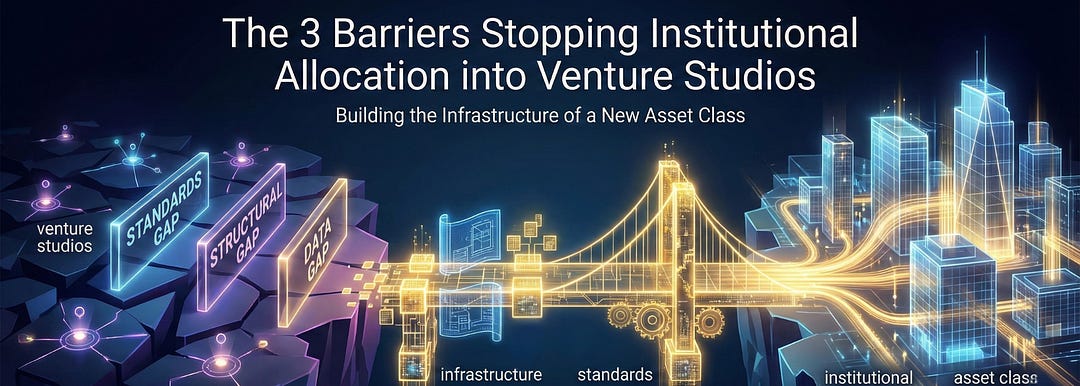
The Three Barriers We Must Cross
The gap between a “emerging asset class” and an “allocatable asset class” requires crossing three critical barriers. This has been our focus for the last year, and it defines our roadmap for the next.
Barrier 1: The Lack of Standards
Traditional VC due diligence has standard boxes: team track record, investment thesis, portfolio construction.
Venture studios break those boxes. “Team” isn’t just partners sourcing deals; it’s operators creating value. “Investment Thesis” is inseparable from the operational thesis. When every studio evaluation becomes bespoke, it creates paralysis for allocators.
What we are doing: We defined the category and published open standards to give investors the clarity they need to begin evaluation.
Barrier 2: The Lack of Structural Frameworks
Unlike established asset classes that use standard legal templates (like NVCA or ILPA), almost every studio today creates a bespoke legal framework.
This imposes a massive due diligence burden on investors. Furthermore, without accepted standards for structuring the studio-portfolio company relationship, institutional allocators perceive heightened risk regarding conflicts of interest.
What we are doing: We are forming a working group to create the “NVCA-equivalent” standards for studio structures and governance. We are building replicable frameworks that make diligence straight forward.
Barrier 3: The Data Gap
You cannot allocate to what you cannot measure.
Right now, we lack the deep, validated data that allows an investor to answer, “Is this studio good?” with reference to meaningful comparisons. No institution wants to be first into a new category, but everyone wants to be second. Data gives them the permission to be second.
What we are doing: This is our most critical active project. We are partnering with researchers from MIT, Harvard, and Stanford on the largest-ever survey of venture studios. This survey is based on our standards and is foundational to creating a full asset class report that explores the performance and performance drivers of the venture studio asset class.
The Path Forward: Building the “NVCA” of Venture Studios
The institutionalization of venture studios isn’t a question of if, but when.
We can compress the timelines that REITs and VCs suffered through because we can learn from their history. But infrastructure doesn’t build itself. It requires coordination across competitors and cooperation among stakeholders.
We are inviting you to help shape this asset class.
If you want to move this industry from “bespoke experiments” to “standard allocation,” we need you involved:
For Operators: Participate in the survey. The “data-driven case” for the studio model depends entirely on the density of our data.
For Investors & Service Providers: Join our working groups. Help us define the standard term sheets and diligence questionnaires that you want to see. Reach out to me on Linkedin or through the Venture Studio Forum.
We are effectively building the NVCA for Venture Studios.
The momentum exists. The coordination is happening. Let’s finish the build.
References
https://www.reit.com/what-reit/history-reits
https://historyofcomputercommunications.info/section/9.8/The-Return-of-Venture-Capital/
https://www.investmentcouncil.org/wp-content/uploads/2024/07/2024-AIC-Pensions-Report_final.pdf
https://en.wikipedia.org/wiki/History_of_private_equity_and_venture_capital
About the Author
Matthew Burris serves as the Senior Director of Research at the Venture Studio Forum, where his mission is to transition venture studios from an emerging asset class to an established asset class. In this role, he leads the creation of the rigorous data frameworks and due diligence standards required for institutional adoption.
This research is built upon the proprietary insights Matthew developed as Partner & Head of Insights at the 9Point8 Collective and study of over 500 venture studios globally. By codifying the methodologies from his advisory work with corporate, university, economic development, and private studios, he provides the Forum with the foundational architecture needed to define the industry.
Connect with Matthew on LinkedIn.