

Venture Studios and the Pursuit of Truth
Moving Beyond Early Performance Claims

The venture capital industry has long been defined by its outliers. Exceptional investments that deliver outsized returns while compensating for the many that fail or merely return capital. This power law distribution shapes everything from fund structures to portfolio strategy, creating an accepted framework for understanding venture performance.
Venture studios bend the power law to engineer better returns. The most widely cited performance figure supporting this assertion comes from Vault Fund’s 2023 Company Creator whitepaper: a 60% average net IRR across studio portfolios. This research represents the highest-quality performance analysis available, based solely on fully exited vehicles, most over ten years old. Yet this compelling data point, drawn from fewer than 20 firms, highlights a critical challenge facing the venture studio asset class: how do you establish institutional credibility on such a limited dataset?
The Promise vs. Reality Gap
The venture studio model’s early performance data suggests transformative potential for institutional portfolios. Studios combine systematic company creation with significant ownership stakes, potentially delivering superior risk-adjusted returns through operational involvement rather than pure capital allocation. For institutional investors seeking alternatives to traditional venture capital’s hit-or-miss approach, this represents an attractive proposition that focused on quality over quantity.
However, promising early performance hasn’t translated to widespread institutional adoption. Despite the 60% average IRR figure and studios’ theoretical advantages, speed to market, capital efficiency, talent leverage, and systematic risk mitigation, institutional investors remain cautious about dedicated venture studio allocations. The disconnect between performance claims and capital flows reveals a fundamental validation challenge that constrains the entire asset class.
Most venture studios are less than five years old, with many still deploying first funds. Even established studios face the typical 7-12 year investment lifecycle before generating meaningful exit data. This timing challenge is compounded by structural diversity within the industry. Unlike traditional venture capital’s standardized 2/20 structure and 10-year fund lifecycle, studios employ varied models, holding companies, traditional funds, hybrid structures, making direct comparisons challenging even when data exists.
Why the VC Comparison Reveals Systemic Problems
The comparison between venture studios’ 60% average IRR and traditional venture capital’s 33% top-quartile IRR, while intriguing, exposes fundamental methodological problems that institutional investors recognize immediately. This isn’t merely a technical issue. It represents a barrier to serious institutional consideration.
Traditional venture capital, like venture studios, follows a power law return distribution. Data from Adam’s Street Partners covering 2001-2022 shows a 2.1x difference between median and top-quartile venture capital fund returns. This performance distribution raises critical questions: if average studio performance sits at 60% IRR, what does top-quartile studio performance look like? Without this data, institutional investors cannot properly calibrate expectations or conduct meaningful peer comparisons.
The methodological challenge runs deeper than sample size. Comparing average performance to top-quartile performance violates basic benchmarking principles that institutional investors rely on for allocation decisions. This flawed comparison framework, necessitated by limited data availability, signals to sophisticated allocators that the asset class lacks the analytical infrastructure required for systematic capital deployment.
Survivorship bias compounds these concerns. The focus on fully exited fund vehicles likely under samples failed studios no longer available to provide performance data. Every emerging asset class faces this challenge, but institutional investors require transparent acknowledgment of these limitations alongside strategies for addressing them.
The Capital Allocation Challenge
For institutional investors, venture studios represent more than an interesting investment opportunity. They potentially constitute a distinct asset class warranting dedicated allocation within alternative investment portfolios. However, realizing this potential requires overcoming significant structural barriers that current data limitations perpetuate.
Institutional capital allocation operates on systematic frameworks that demand consistent evaluation criteria, benchmarking capabilities, and risk-return calibration. Venture studios’ structural complexity, spanning idea generation, company formation, operational support, and investment. Requires more nuanced evaluation than conventional venture due diligence approaches. Without standardized assessment frameworks, investors struggle to compare studios meaningfully or determine appropriate portfolio positioning.
The challenge extends beyond performance measurement to fundamental questions about operational scalability, governance structures, and risk management approaches. Institutional investors need confidence that studios can deploy significant capital efficiently while maintaining quality control and operational discipline. Current data limitations prevent sophisticated analysis of what drives studio success, hampering institutional investors’ ability to conduct thorough due diligence or construct optimized studio portfolios.
This capital access constraint creates a self-reinforcing problem for the asset class. Without institutional validation, studios struggle to raise the capital necessary to scale operations and prove their model’s durability across market cycles. This limits the data generation that would enable more comprehensive performance analysis, perpetuating the credibility gap that constrains institutional adoption.
What Institutional Validation Requires
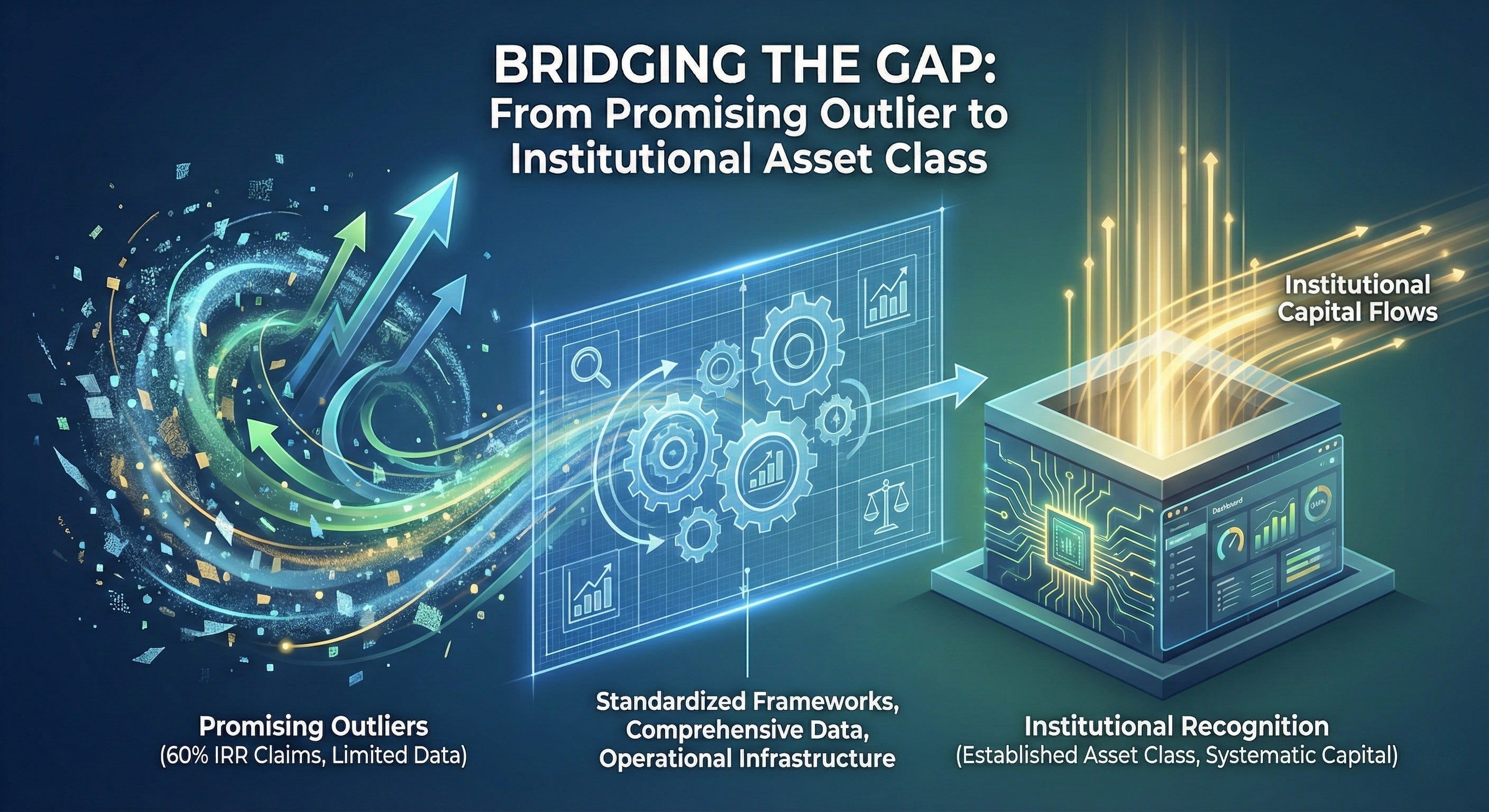
Moving beyond early performance claims requires building comprehensive infrastructure that meets institutional investors’ systematic needs. This extends far beyond headline IRR figures to encompass multiple dimensions of studio evaluation and industry standardization.
Performance Measurement Evolution Institutional investors require frameworks that capture venture studios’ multidimensional value creation approach. Traditional metrics like IRR and TVPI remain important but insufficient for evaluating entities that combine private equity’s operational involvement, venture capital’s risk tolerance, and corporate innovation’s systematic processes. Studios’ ability to kill ideas early, pivot quickly, and deploy resources efficiently across portfolios suggests potential for superior risk-adjusted returns, but current metrics don’t capture these nuances.
The Venture Studio Index, an open standard contributed to the Venture Studio Forum by the 9point8 Collective to steward the standard for the community, addresses these measurement challenges through systematic evaluation across five dimensions: formation role, return profile, operational capabilities, cost structure, and portfolio construction. Rather than relying on headline figures alone, this framework enables investors to assess underlying performance drivers, from capital efficiency metrics to operational scalability indicators.
Structural Standardization Institutional adoption requires legal and fund structures that investors recognize and trust, alongside institutional-grade due diligence processes enabling consistent cross-studio comparisons. This includes documented operational discipline for company creation, governance, and spinout management, plus clear industry definitions avoiding confusion with adjacent models.
Studios must also develop regularized performance reporting that balances narrative context with quantitative rigor. The economic opacity created by complex fee structures and service arrangements must give way to transparent frameworks that institutional investors can analyze systematically.
Operational Infrastructure Beyond measurement and structure, institutional validation requires proof that studios can maintain quality and efficiency at scale. This includes demonstrating systematic talent development, repeatable company creation processes, and robust governance frameworks that protect investor interests while enabling operational flexibility.
VSF’s Systematic Solution
The Venture Studio Forum is running the industry’s largest and most comprehensive survey of venture studios with the support of researchers from MIT, Harvard, and Stanford. This systematic data collection initiative is designed to establish the empirical foundation this asset class requires for institutional recognition. This extensive research effort addresses the fundamental data limitations constraining institutional adoption through multiple coordinated approaches.
Comprehensive Data Collection The survey captures performance metrics, structural variations, and operational benchmarks from studios worldwide, creating the first comprehensive database for institutional analysis. This initiative directly addresses the sample size problem that undermines current performance claims while providing the geographic and structural diversity necessary for sophisticated comparative analysis.
Beyond performance data, the initiative will document the operational factors that drive studio success, enabling evidence-based analysis of what distinguishes high performing studios from their peers. This granular data will support the development of institutional-grade due diligence frameworks and risk assessment methodologies.
Ecosystem Infrastructure Development The resulting database will provide essential infrastructure for the entire ecosystem: searchable tools enabling entrepreneurs, operators, and investors to identify optimal studio partnerships; comprehensive geographic mapping of global studio operations; and detailed case studies documenting both successes and failures across different models and markets.
This infrastructure development addresses institutional investors’ need for systematic comparison tools while providing the transparency that sophisticated allocators require for portfolio construction and risk management.
Academic Validation Critically, this research will provide academic researchers with the baseline dataset needed to conduct rigorous analysis of studio success factors. The resulting peer-reviewed research will help institutionalize venture studios through academic validation, moving beyond anecdotal evidence to establish evidence-based best practices that institutional investors can rely on for allocation decisions.
Building the Foundation for Institutional Recognition
The ultimate measure of success for this initiative will be achieved when capital allocators maintain dedicated venture studio allocations within their alternative investment portfolios. Viewing studios not as an experimental subset of venture capital, but as a distinct asset class with proven risk-return characteristics and standardized evaluation frameworks.
This transformation from promising early performance claims to institutional recognition depends on systematic, data driven foundation building that addresses the full spectrum of institutional investor needs. Performance data alone, while necessary, is insufficient. The asset class requires comprehensive infrastructure encompassing measurement frameworks, structural standardization, operational discipline, and academic validation.
The venture studio model represents genuine innovation in company building, with theoretical advantages supported by compelling early performance data. However, its future depends not on defending these early claims, but on building the analytical and operational infrastructure that enables institutional investors to allocate capital systematically and confidently.
By participating in this comprehensive data collection effort, studios contribute to establishing the credibility and analytical rigor that institutional investors require. The result will be an asset class equipped with the transparency, standardization, and proven performance record necessary to unlock the significant institutional capital flows that can accelerate studio creation and scaling globally.
The industry’s evolution from promising outlier to established asset class requires this kind of systematic foundation building. The Venture Studio Forum’s initiative represents a critical step toward that institutional recognition, creating the data infrastructure and analytical frameworks that will enable venture studios to realize their full potential as a transformative approach to company creation.
Author’s Note
This article draws on Vault Fund whitepapers and discussions with multiple venture studio operators, LPs, and ecosystem participants. Conclusions reflect observed patterns in the category’s development combined with forward-looking interpretations of institutional validation requirements. This analysis is for informational purposes only and should not be relied upon for investment decisions.
About the Author
Matthew Burris serves as the Senior Director of Research at the Venture Studio Forum, where his mission is to transition venture studios from an emerging asset class to an established asset class. In this role, he leads the creation of the rigorous data frameworks and due diligence standards required for institutional adoption.
This research is built upon the proprietary insights Matthew developed as Partner & Head of Insights at the 9Point8 Collective and study of over 500 venture studios globally. By codifying the methodologies from his advisory work with corporate, university, economic development, and private studios, he provides the Forum with the foundational architecture needed to define the industry.
Connect with Matthew on LinkedIn.
Couldn't agree more. That line about "how do you establish institutional credibility on such a limited datasett?" really hit me. It's the core challenge you've articulated so well.